Due to my pretention to academic worthiness, I have Google Scholar alert me to all my new citations. That is, citations to My Papers. I got an anodyne alert the other day and, as usual, gave it a quick once-over. Anything new or interesting? Any new signal-processing twist or a machine-learning breakthrough, finally smashing the last vestiges of the old order? I’m referring here to The Literature [R205].
Well … no. But some modern AI-related weirdness is there, and it is a concerning variety of weirdness for researchers that attempt to learn from published technical work, and especially for those that attempt to use references in a published technical paper to dig a little deeper toward foundational material. Let’s take a look.
[R205] is called “Covert Routing with DSSS Signaling Against Cycle Detectors,” and it is concerned with a multi-hop message-transmission scheme using multiple pairs of transmitters and receivers and wireless transmissions. The physical-layer signals are direct-sequence spread-spectrum BPSK signals, with which we are very familiar.
The idea is that a communicator named Alice wants to send a message to a communicator named Bob (See Figure 1), but there is an interceptor named Willie that is trying to detect their transmission (for presumably nefarious reasons). Willie can use an energy detector or what the authors call a cycle detector. I was in on the ground floor of what are commonly called cycle detectors–see the early CSP Blog post on cycle detectors here.

When the authors get around to defining their cycle detector mathematically, what we see is reproduced in Figure 2.

 , but the spectral correlation estimate is not. More importantly, the spectral correlation estimate is the cyclic periodogram, which does not converge to the spectral correlation function as
  increases.
Their reference [11] is my paper My Papers [1], which is “Signal Interception: Performance Advantages of Cyclic-Feature Detectors,” which is indeed a paper about cycle detectors. Unfortuately for [R205], the “Degree of Cyclostationarity” phrase and definition never appears in My Papers [1]. The authors supply, in Figure 2, an estimate of the spectral correlation function for 

More disturbing, and more to the point about possible AI misuse, is the reference in Figure 2 to [15] as relating to, or containing a definition of, the finite-time complex spectrum. But [15] is a half-page book review, written by Enders Robinson about Gardner’s book The Literature [R1]. You can see the full review in Figure 3. Note that the citation [15] simply says:
W. A. Gardner and E. A. Robinson, “Statistical Spectral Analysis–A Nonprobabilistic Theory,” 1989.

Note that The Literature [R1] has that same title, but was published in 1987. The Robinson review came out in 1989.
To be clear, the relevant part of the reference list in R205 is shown in Figure 4.

It is nice to be cited. But the citations here are essentially dead ends. If someone went looking for the exposition on degree of cyclostationarity in [11] or the finite-time complex spectrum, they would be stymied. Perhaps they would just stop that part of their investigation.
The most pressing question is: How can this happen? There is a paper by Gardner and Zivanovic called “Degrees of Cyclostationarity and Their Application to Signal Detection and Estimation” written in 1991 (The Literature [R206]). That’s actually the only one I know of that defines and discusses DCS. My CSP colleagues and I don’t use it. The spectral coherence is a much better detection statistic. So how can these researchers, who reference their own work that also seems to relate to CSP (their [3] and [5], for example), mangle all these references and citations? Why does their [15] just have authors, title, and year? Where was it published?
Moving on, as the authors gear up for presentation of numerical results, they now reference their [16] (My Papers [17]) in support of DCS, as shown in Figure 5. My Papers [17] never mentions DCS, you will not be surprised to learn.


These errors have a familiar flavor to me. I’ve tried to use a large language model (LLM) a couple of times when searching for published papers relevant to some technical topic. The citations can be wrong. I believe that is what is happening here. The authors either didn’t use LLMs and are terrible at scholarship or they did, and they are terrible at scholarship.
So watch out! Researchers may now be citing your papers for bad reasons and causing other researchers to miss out on your work because they encounter dead ends in the reference list.
On to Some Technical Concerns
The AI/citation weirdness got me looking too closely at this paper and I dove down the rabbit hole a bit. It ain’t pretty.
Notice that the DCS definition (their (2) in my Figure 2 above) uses the theoretical spectral correlation function for some infinitely long signal or a random process signal model. If we want to convert that to an estimate of the DCS, we have to replace the theoretical spectral correlation function with an estimate. Further, if we want the DCS estimate to converge to its theoretical (limit) value, a sufficient condition is that the spectral correlation estimates themselves converge to the theoretical spectral correlation function values. I say “sufficient” because it isn’t clear that it is necessary; you’d have to prove that. For example, if the spectral correlation estimates converge to the theoretical spectral correlation values except for a countable number of values of frequency 
But we can also notice that for some spectral correlation estimators, the estimated DCS cannot converge to its theoretical value. Furthermore, the DCS will not be useful in such cases. One of those cases is, in fact, the estimator used by the authors–the cyclic periodogram.
Consider the case where the data 

When we substitute the cyclic periodogram for the theoretical spectral correlation in (2), however, we see that the integrands in the numerator do not get small as the block length increases. This is because the cyclic periodogram (and the periodogram) never converge to anything as the block length increases without bound. The integral is over the squared magnitude of this erratic function, and so cannot converge to zero–the integral must add up a large number of positive numbers. So the DCS for stationary noise with the cyclic periodogram used as the spectral correlation estimate will NOT converge to the theoretical value of zero. Similarly, the DCS for some cyclostationary signal using the cyclic periodogram will NOT converge to its theoretical value.
Let’s test it out. We select a DSSS BPSK signal (as do the authors) with processing gain 127, chip rate 0.5 (normalized frequencies used here), and square-root raised-cosine pulse shaping with excess bandwidth (roll-off) of 1.0. This implies non-conjugate cycle frequencies of 

We estimate the DCS using two spectral correlation estimators. The first is the authors’ cyclic periodogram and the second is the frequency-smoothed cyclic periodogram with smoothing-window width of 0.02 (2 percent of the sampling rate of 1).
The signal and noise both have unit power, which means that the inband SNR is 0 dB since the occupied bandwidth of the signal is approximately equal to the sampling rate.
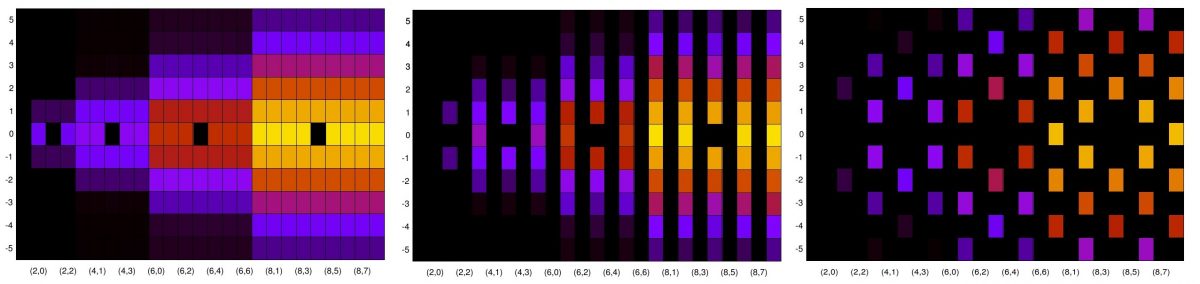
We’ll consider estimator block lengths (in samples) that are powers of two starting with 8192 and ending with 4194304. A typical result in shown in Figure 6. The authors’ estimator corresponds to 


 is zero, the DCS estimate corresponds to the authors’ estimate.
The DCS estimates for all block lengths are shown in Figure 7. The DCS for the frequency-smoothing method works as expected. As the block length increases, the DCS of the noise-only signal converges to zero as noise is not cyclostationary. The DCS for the noisy signal approaches a constant relating to the particular integrals of the squared spectral correlation functions, which relate to the signal type, spreading code, signal power, and noise power.

On the other hand, the DCS for the cyclic periodogram estimator does not behave as desired. The DCS for noise does not converge to zero. Moreover, the DCS for the noisy signal is smaller than the DCS for the noise only.
Finally, when the authors do their numerical example, they specify the data length for their cyclic periodogram, as in Figure 8.

Earlier in the paper, the symbol 

The simulation code is available at https://github.com/swapnil-saha/Covert-Routing-with-DSSS-Signaling-Against-Cycle-Detectors.git
and that repository exists, but it just says that the code is coming soon.
I’ll watch out for it.

Great article Chad,
AI use in research has made an existing problem: sloppy research. I have found LLMs very useful in for helping me to identify research papers or new topics, but it is it is like sending elementary students into the library to find relevant research articles, a large portion of what they bring back is not relevant.
What concerns me most is students are treating an LLM as a primary source. This combined with the ease at which modern LLMs allow one to generate slop papers will make the situation much worse.
The average quality of published papers diminishes as the cost of producing the paper drops, LLMs have accelerated this process.