Cyclic Polyspectra

Higher-order statistics in the frequency domain for cyclostationary signals. As complicated as it gets at the CSP Blog.

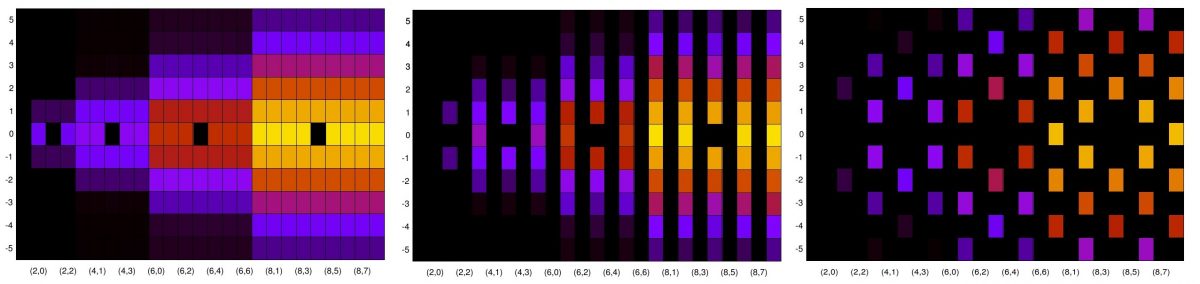
In this post we take a first look at the spectral parameters of higher-order cyclostationarity (HOCS). In previous posts, I have introduced the topic of HOCS and have looked at the temporal parameters, such as cyclic cumulants and cyclic moments. Those temporal parameters have proven useful in modulation classification and parameter estimation settings, and will likely be an important part of my ultimate radio-frequency scene analyzer.

The spectral parameters of HOCS have not proven to be as useful as the temporal parameters unless you include the trivial case where the moment/cumulant order is equal to two. In that case, the spectral parameters reduce to the spectral correlation function, which is extremely useful in CSP (see the TDOA and signal-detection posts for examples).

Continue reading “Cyclic Polyspectra”

Comments on “Cyclostationary Correntropy: Definition and Application” by Fontes et al

Update: See also some other reviews/take-downs of cyclic correntropy on the CSP Blog here and here.


I recently came across a published paper with the title Cyclostationary Correntropy: Definition and Application, by Aluisio Fontes et al. It is published in a journal called Expert Systems with Applications (Elsevier). Actually, it wasn’t the first time I’d seen this work by these authors. I had reviewed a similar paper in 2015 for a different journal.

I was surprised to see the paper published because I had a lot of criticisms of the original paper, and the other reviewers agreed since the paper was rejected. So I did my job, as did the other reviewers, and we tried to keep a flawed paper from entering the literature, where it would stay forever causing problems for readers.

The editor(s) of the journal Expert Systems with Applications did not ask me to review the paper, so I couldn’t give them the benefit of the work I already put into the manuscript, and apparently the editor(s) did not themselves see sufficient flaws in the paper to merit rejection.

It stings, of course, when you submit a paper that you think is good, and it is rejected. But it also stings when a paper you’ve carefully reviewed, and rejected, is published anyway.

Fortunately I have the CSP Blog, so I’m going on another rant. After all, I already did this the conventional rant-free way.

Continue reading “Comments on “Cyclostationary Correntropy: Definition and Application” by Fontes et al”