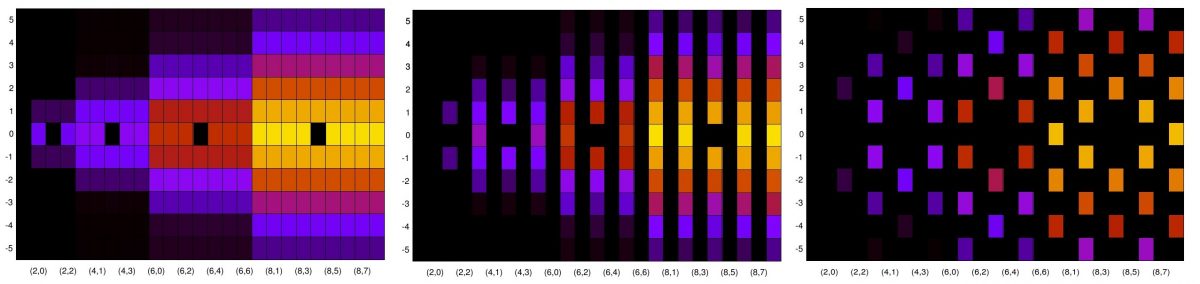
In this post I continue the development of the theory of higher-order cyclostationarity (My Papers [5,6]) that I began here. It is largely taken from my doctoral work (download my dissertation here).
This is a long post. To make it worthwhile, I’ve placed some movies of cyclic-cumulant estimates at the end. Or just skip to the end now if you’re impatient!
In my work on cyclostationary signal processing (CSP), the most useful tools are those for estimating second-order statistics, such as the cyclic autocorrelation, spectral correlation function, and spectral coherence function. However, as we discussed in the post on Textbook Signals, there are some situations (perhaps only academic; see my question in the Textbook post) for which higher-order cyclostationarity is required. In particular, a probabilistic approach to blind modulation recognition for ideal (textbook) digital QAM, PSK, and CPM requires higher-order cyclostationarity because such signals have similar or identical spectral correlation functions and PSDs. (Other high-SNR non-probabilistic approaches can still work, such as blind constellation extraction.)
Recall that in the post introducing higher-order cyclostationarity, I mentioned that one encounters a bit of a puzzle when attempting to generalize experience with second-order cyclostationarity to higher orders. This is the puzzle of pure sine waves (My Papers [5]). Let’s look at pure and impure sine waves, and see how they lead to the probabilistic parameters widely known as cyclic cumulants.
 , and the
  .
. . For the
  are required, and the frequency resolution is
  (in normalized frequency units).
 defined for two random variables
  and
and  as
as![\rho = \displaystyle \frac{E[(X - m_X)(Y - m_Y)]}{\sigma_X \sigma_Y}, \hfill (1)](https://s0.wp.com/latex.php?latex=%5Crho+%3D+%5Cdisplaystyle+%5Cfrac%7BE%5B%28X+-+m_X%29%28Y+-+m_Y%29%5D%7D%7B%5Csigma_X+%5Csigma_Y%7D%2C+%5Chfill+%281%29&bg=ffffff&fg=1a1a1a&s=0&c=20201002)
 and
and  are the mean values of
  and
and  are the standard deviations of
 ![m_X = E[X] \hfill (2)](https://s0.wp.com/latex.php?latex=m_X+%3D+E%5BX%5D+%5Chfill+%282%29&bg=ffffff&fg=1a1a1a&s=0&c=20201002)
![m_Y = E[Y] \hfill (3)](https://s0.wp.com/latex.php?latex=m_Y+%3D+E%5BY%5D+%5Chfill+%283%29&bg=ffffff&fg=1a1a1a&s=0&c=20201002)
![\sigma_X^2 = E[(X-m_X)^2] \hfill (4)](https://s0.wp.com/latex.php?latex=%5Csigma_X%5E2+%3D+E%5B%28X-m_X%29%5E2%5D+%5Chfill+%284%29&bg=ffffff&fg=1a1a1a&s=0&c=20201002)
![\sigma_Y^2 = E[(Y-m_Y)^2] \hfill (5)](https://s0.wp.com/latex.php?latex=%5Csigma_Y%5E2+%3D+E%5B%28Y-m_Y%29%5E2%5D+%5Chfill+%285%29&bg=ffffff&fg=1a1a1a&s=0&c=20201002)