CSP Estimators: The Strip Spectral Correlation Analyzer

The SSCA is a good tool for blind (no prior information) exhaustive (all cycle frequencies) spectral correlation analysis. An alternative is the FFT accumulation method.

In this post I present a very useful blind cycle-frequency estimator known in the literature as the strip spectral correlation analyzer (SSCA) (The Literature [R3-R5]). We’ve covered the basics of the frequency-smoothing method (FSM) and the time-smoothing method (TSM) of estimating the spectral correlation function (SCF) in previous posts. The TSM and FSM are efficient estimators of the SCF when it is desired to estimate it for one or a few cycle frequencies (CFs). The SSCA, on the other hand, is efficient when we want to estimate the SCF for all CFs.

See also an alternate method of efficient exhaustive SCF estimation: The FFT Accumulation Method.

Continue reading “CSP Estimators: The Strip Spectral Correlation Analyzer”

Second-Order Estimator Verification Guide

Use this post to help check the accuracy of your second-order CSP estimators.

Update September 2022: New section on the non-conjugate and conjugate coherence function.

***

In this post I provide some tools for the do-it-yourself CSP practitioner. One of the goals of this blog is to help new CSP researchers and students to write their own estimators and algorithms. This post contains some spectral correlation function and cyclic autocorrelation function estimates and numerically evaluated formulas that can be compared to those produced by anybody’s code.

The signal of interest is, of course, our rectangular-pulse BPSK signal with symbol rate 0.1 (normalized frequency units) and carrier offset 0.05. You can download a MATLAB script for creating such a signal here.

The formula for the SCF for a textbook BPSK signal is published in several places (The Literature [R47], My Papers [6]) and depends mainly on the Fourier transform of the pulse function used by the textbook signal.

We’ll compare the numerically evaluated spectral correlation formula with estimates produced by my version of the frequency-smoothing method (FSM). The FSM estimates and the theoretical functions are contained in a MATLAB mat file here. (I had to change the extension of the mat file from .mat to .doc to allow posting it to WordPress–change it back after downloading. It is a zipped .mat file as of 12/2/22.) In all the results shown here and that you can download, the processed data-block length is 65536 samples and the FSM smoothing width is 0.02 Hz. A rectangular smoothing window is used. For all cycle frequencies except zero (non-conjugate), a zero-padding factor of two is used in the FSM.

For the cyclic autocorrelation, we provide estimates using two methods: inverse Fourier transformation of the spectral correlation estimate and direct averaging of the second-order lag product in the time domain.

Continue reading “Second-Order Estimator Verification Guide”
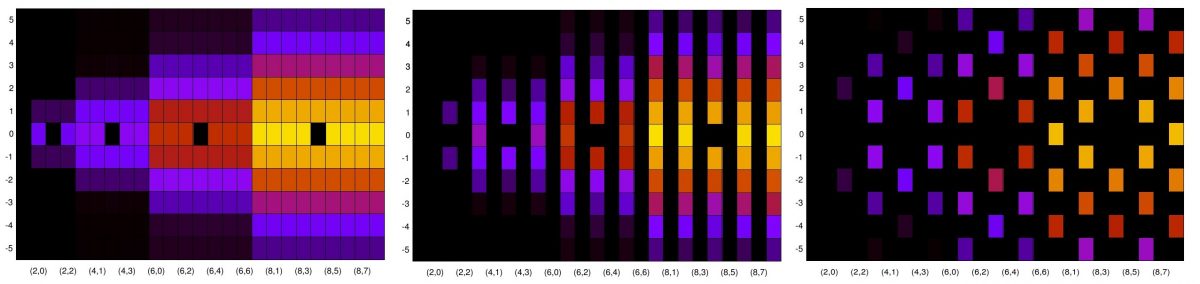
A Gallery of Spectral Correlation

Pictures are worth N words, and M equations, where N and M are large integers.

In this post I provide plots of the spectral correlation for a variety of simulated textbook signals and several captured communication signals. The plots show the variety of cycle-frequency patterns that arise from the disparate approaches to digital communication signaling. The distinguishability of these patterns, combined with the inability to distinguish based on the power spectrum, leads to a powerful set of classification (modulation recognition) features (My Papers [16, 25, 26, 28]).

In all cases, the cycle frequencies are blindly estimated by the strip spectral correlation analyzer (The Literature [R3, R4]) and the estimates used by the FSM to compute the spectral correlation function. MATLAB is then used to plot the magnitude of the spectral correlation and conjugate spectral correlation, as specified by the determined non-conjugate and conjugate cycle frequencies.

There are three categories of signal types in this gallery: textbook signals, captured signals, and feature-rich signals. The latter comprises some captured signals (e.g., LTE) and some simulated radar signals. For the first two signal categories, the three-dimensional surface plots I’ve been using will suffice for illustrating the cycle-frequency patterns and the behavior of the spectral correlation function over frequency. But for the last category, the number of cycle frequencies is so large that the three-dimensional surface is difficult to interpret–it is a visual mess. For these signals, I’ll plot the maximum spectral correlation magnitude over spectral frequency f versus the detected cycle frequency \alpha (as in this post).

A complementary gallery of cyclic autocorrelation functions can be found here.

Continue reading “A Gallery of Spectral Correlation”

SCF Estimate Quality: The Resolution Product

What factors influence the quality of a spectral correlation function estimate?

The two non-parametric spectral-correlation estimators we’ve looked at so far–the frequency-smoothing and time-smoothing methods–require the choice of key estimator parameters. These are the total duration of the processed data block, T, and the spectral resolution F.

For the frequency-smoothing method (FSM), an FFT with length equal to the data-block length T is required, and the spectral resolution is equal to the width F of the smoothing function g(f). For the time-smoothing method (TSM), multiple FFTs with lengths T_{tsm} = T / K are required, and the frequency resolution is 1/T_{tsm} (in normalized frequency units).

The choice for the block length T is partially guided by practical concerns, such as computational cost and whether the signal is persistent or transient in nature, and partially by the desire to obtain a reliable (low-variance) spectral correlation estimate. The choice for the frequency (spectral) resolution is typically guided by the desire for a reliable estimate.

Continue reading “SCF Estimate Quality: The Resolution Product”

The Spectral Coherence Function

Cross correlation functions can be normalized to create correlation coefficients. The spectral correlation function is a cross correlation and its correlation coefficient is called the coherence.

In this post I introduce the spectral coherence function, or just coherence. It deserves its own post because the coherence is a useful detection statistic for blindly determining significant cycle frequencies of arbitrary data records. See the posts on the strip spectral correlation analyzer and the FFT accumulation method for examples.

Let’s start with reviewing the standard correlation coefficient \rho defined for two random variables X and Y as

\rho = \displaystyle \frac{E[(X - m_X)(Y - m_Y)]}{\sigma_X \sigma_Y}, \hfill (1)

where m_X and m_Y are the mean values of X and Y, and \sigma_X and \sigma_Y are the standard deviations of X and Y. That is,

m_X = E[X] \hfill (2)

m_Y = E[Y] \hfill (3)

\sigma_X^2 = E[(X-m_X)^2] \hfill (4)

\sigma_Y^2 = E[(Y-m_Y)^2] \hfill (5)

So the correlation coefficient is the covariance between X and Y divided by the geometric mean of the variances of X and Y.

Continue reading “The Spectral Coherence Function”

CSP Estimators: The Time Smoothing Method

The non-blind spectral-correlation estimator called the TSM is favored when one wishes to avoid long FFTs.

In a previous post, we introduced the frequency-smoothing method (FSM) of spectral correlation function (SCF) estimation. The FSM convolves a pulse-like smoothing window g(f) with the cyclic periodogram to form an estimate of the SCF. An advantage of the method is that it allows fine control over the spectral resolution of the SCF estimate through the choice of g(f), but the drawbacks are that it requires a Fourier transform as long as the data-record undergoing processing, and the convolution can be expensive. However, the expense of the convolution can be mitigated by using rectangular g(f).

In this post, we introduce the time-smoothing method (TSM) of SCF estimation. Instead of averaging (smoothing) the cyclic periodogram over spectral frequency, multiple cyclic periodograms are averaged over time. When the non-conjugate cycle frequency of zero is used, this method produces an estimate of the power spectral density, and is essentially the Bartlett spectrum estimation method. The TSM can be found in My Papers [6] (Eq. (54)), and other places in the literature.

Continue reading “CSP Estimators: The Time Smoothing Method”

CSP Estimators: The Frequency-Smoothing Method

The non-blind spectral-correlation estimator called the FSM is favored when one wishes to have fine control over frequency resolution and can tolerate long FFTs.

In this post I describe a basic estimator for the spectral correlation function (SCF): the frequency-smoothing method (FSM). The FSM is a way to estimate the SCF for a single value of cycle frequency. Recall from the basic theory of the cyclic autocorrelation and SCF that the SCF is obtained by infinite-time averaging of the cyclic periodogram or by infinitesimal-resolution frequency averaging of the cyclic periodogram. The FSM is merely a finite-time/finite-resolution approximation to the SCF definition.

One place the FSM can be found is in (My Papers [6]), where I introduce time-smoothed and frequency-smoothed higher-order cyclic periodograms as estimators of the cyclic polyspectrum. When the cyclic polyspectrum order is set to n = 2, the cyclic polyspectrum becomes the spectral correlation function, so the FSM discussed in this post is just a special case of the more general estimator in [6, Section VI.B].

Continue reading “CSP Estimators: The Frequency-Smoothing Method”