An advantage of using and understanding the statistics of communication signals ™, the basics of signal processing, and the rich details of cyclostationary signal processing is that a practitioner can deal with, to some useful degree, unknown unknowns. The unknown unknowns I’m talking about here on the CSP Blog are, of course, signals. We know about the by-now-familiar known-type detection, multi-class modulation-recognition, and RF scene-analysis problems, in which it is often assumed that we know the signals we are looking for, but we don’t know their times of arrival, some of their parameters, or how they might overlap in time, frequency, and space. Then there are the less-familiar problems involving unknown unknowns.
Sometimes we just don’t know the signals we are looking for. We still want to do as good a job on RF scene analysis as we can, but there might be signals in the scene that do not conform to the body of knowledge we have, to date, of manmade RF signals. Or, in modern parlance, we didn’t even know we left such signals out of our neural-network training dataset; we’re a couple steps back from even worrying about generalization, because we don’t even know we can’t generalize since we are ignorant about what to generalize to.
In this post I look at the broadcast TV band, seen in downtown Monterey, California, sometime in the recent past. I expect to see ATSC DTV signals (of the older 8VSB/16VSB or the newer OFDM types), and I do. But what else is there? Spoiler: Unknown unknowns.
Let’s take a look.
ATSC_DTV_fc_575MHz_fs_100MHz
The first captured DTV signal file is called ATSC_DTV_fc_575MHz_fs_100MHz and as can be gleaned from this ungainly filename, the center frequency of my receiver was set to 575 MHz and the sampling rate was commanded to be 100 MHz. Since each ATSC DTV channel is 6 MHz wide, and 575 MHz is not near the edges of the licensed TV band, the captured-data bandwidth contains about 100/6 = 16 channels.
The first thing I did was to look at the power spectrum for some of the subblocks of the file to ensure that the captured data “looks like” the power spectrum displayed on my spectrum analyzer. You can see a typical power spectrum estimate in Figure 1 (blue line).
Next I enforced a kind of channelization on the data blocks so I could extract and process each known channel. The TV channels have center frequencies 473 MHz + 6k MHz. So in Figure 1, the center frequencies are 539, 545, …, 599, 605 MHz. Each of the (older 8VSB/16VSB) ATSC DTV signals has a pilot tone that is located 2.69 MHz below the channel center frequency. So you can see the tones for several of the signals in Figure 1, but not all are visible, which is due to propagation-channel effects.
Now some of the channels in Figure 1 are not, apparently, occupied by a DTV signal, such as the channel for band of interest 10 at center frequency 593 MHz. And there is some suspicious non-DTV-looking energy between 600 and 620 MHz.

When the band-of-interest detector is forced to produce bands-of-interest that correspond to the known ATSC DTV channel locations, as in Figure 1, we would expect to see cycle-frequency patterns and spectral correlation functions that conform to the ATSC DTV modulation types for each BOI’s extracted complex envelope. Typically that means the channel is occupied by a digital vestigial sideband (VSB) signal, which is essentially a severely filtered pulse-amplitude modulated signal. The severe filtering allows the 10.7622 MHz symbol-rate signal to squeeze itself into the allowed 6 MHz DTV band. Also, the severe filtering removes all non-conjugate cyclostationarity (except 

Next, I used the strip spectral correlation analyzer (SSCA) to process the data file in blocks of 1,048,576 samples to find all the significant cycle frequencies across the entire captured 100-MHz RF band. Here is where some surprises were encountered. I see several sets of harmonically related non-conjugate cycle frequencies. To visualize the results, for each block’s detected cycle frequencies, I employ the frequency-smoothing method (FSM) of spectral correlation estimation to estimate the non-zero portion of the 
 for ATSC DTV signals, so there is Something Going On Here ™.
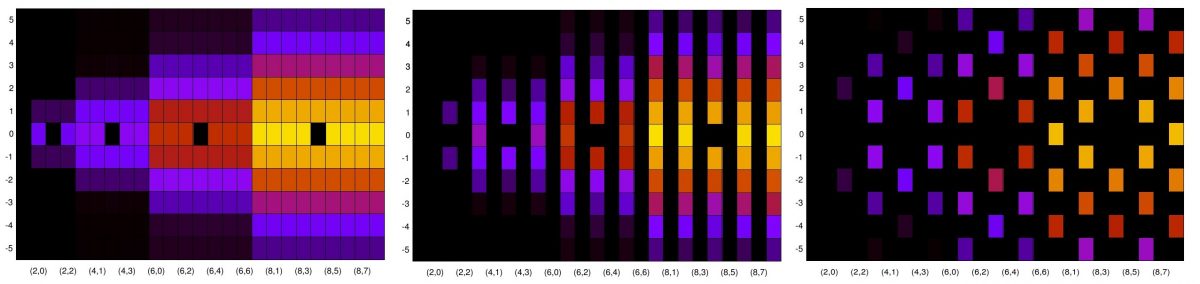
What we see from the cyclic-domain profile (CDP), which is the middle plot in the frames of Video 1, is at least four sets of relatively strong harmonically related cycle frequencies.
Taking a closer look at a typical data block, we can identify the four cycle-frequency chains as having fundamental frequencies of 597.5, 602.8, 616.4, and 633.4 kHz, as shown in Figure 3. These cycle-frequency chains extend to cycle frequencies of at least 9 MHz, which means whatever signal(s) is giving rise to them extends past the boundaries of any one DTV channel (why?).

My CSP-based modulation-recognition system also finds these cycle frequencies and attempts to match their patterns to patterns in its catalog of signal types. The closest signal type is multi-h CPM, which is a form of continuous-phase modulation (My Papers [8]) that uses a periodically time-varying set of modulation indices. This ends up producing four or five harmonically related non-conjugate cycle frequencies, but no single multi-h CPM signal can produce four sets of harmonically related cycle frequencies with 9 or so harmonics (well, I don’t think they can). So the fit is not good.
The pattern in Figure 3 is reminiscent of radar signals, which are periodic and so possess first-order cyclostationarity. When subjected to spectral correlation analysis (second-order cyclostationarity), the first-order sine-waves in the signal multiply each other, and you have a (trivially) second-order cyclostationary signal. Typical radar signals are harmonic-rich, meaning their Fourier-series representations require many non-zero Fourier coefficients for an accurate representation–typically many more than 9, and unless the radar signal is agile (time-varying) or there are multiple radars present, it would not produce four distinct cycle-frequency chains.
So, what is it that is hiding under the TV here? An unknown unknown.
TV_Band_fs_100MHz_fc_521MHz
The next file is called TV_Band_fs_100MHz_fc_521MHz and a typical PSD, with forced-channelization BOIs aligned with the known broadcast channel boundaries, is shown in Figure 4.

For this captured-data file, it appears there is something hiding under the signals near midband (channels 7 and 8 in Figure4). Video 2 reveals a significant number of non-conjugate cycle frequencies associated with a spectral center frequency near 520 MHz. The cycle frequencies extend out past 6 MHz, indicating that there are temporally correlated spectral components on either side of 520 MHz with separations exceeding a single DTV channel width (why?).
for ATSC DTV signals, so once again there is Something Going On Here ™.DTV_557MHz_100MHz
Finally, my favorite example of this desultory trip through the cyclostationarity of oddball signals in the broadcast TV band: DTV_557MHz_100MHz. A typical PSD is shown in Figure 5, along with the familiar (by now) forced band-of-interest channelization along the known channel boundaries.

Looks pretty normal by now, what with the occupied bands having obvious 6-MHz-wide signals with little pilot-tone peaks on their left sides, a couple stray tones here and there, some unoccupied bands, and—wait, what is THAT? That half-width signal sitting quietly in Channel 4? With what looks like a little tone on the right side of its spectrum?
If we process the entire band, as we did with the other two captured-data files, we obtain the cycle frequencies and spectral correlation plots shown in Video 3. Once again, this kind of analysis is revealing correlations that I cannot yet explain.
for ATSC DTV signals, and there is funny business in the PSD, so now there is REALLY Something Going On Here ™.Extracting the signal at 533 MHz, and performing the blind processing used in Videos 1-3 leads to Video 4, which just focuses on that one 6-MHz band centered at 533 MHz. You can see a cycle-frequency pattern of 20-30 harmonics of about 31.4 kHz, a much smaller fundamental frequency than for the cycle-frequency chains we saw for ATSC_DTV_fc_575MHz_fs_100MHz.
The PSD, spectral correlation shapes, and long cycle-frequency chain is similar to the cyclostationarity of DMR, and the spectrum is also quite similar to many radar power spectra.
So that’s it for this meandering CSP adventure. What is hiding underneath the TV? I don’t know! But I was able to extract a lot of information about what might be hiding there, and so maybe I can complete this tale in the future, converting unknown unknowns into one or more known unknowns.
If you have any tips, comments, or especially corrections, please feel free to leave a note in the Comments section below.

Desultory . . . you sent me to the dictionary again.
Stephen R. Donaldson, of Lord Foul’s Bane fame, is an author that sends me to the dictionary a lot. So perhaps you have him to thank.
Don’t miss my previous two desultory excursions:
Desultory CSP: The Human-Genome Edition
Desultory CSP: More Signals from SigIDWiki.com
You mention that for the dataset ATSC_DTV_fc_575MHz_fs_100MHz, bands-of-interest (BOI) 13 and 14 do not appear to be DTV.
BOI 13 corresponds to ASTC channel 37. This is a “dummy” channel and reserved for radio astronomy according to US spectrum allocation.
BOI 14 corresponds to ATSC channel 38. All ATSC channels 38 and above were decommissioned at the end of 2023, but many started this decommissioning process years before. As of 2024 that band is now allocated to mobile communications, if I recall correctly.
So it would make sense that 608 MHz and above are not DTV.
Thank you Dylan!
Is ATSC DTV channel 37 reserved for radio astronomy across the entire continental US?
Hi, Chad. Yes, that is correct. After doing a little digging it looks like there is one exception– Wireless Medical Telemetry Service (WMTS).
From the WMTS Wikipedia:
“…Further, the use of these bands has not been internationally agreed to, so many times devices cannot be marketed or used freely in countries other than the United States. Because of this, in addition to WMTS, many manufacturers have created devices that transmit data in the ISM bands such as 902-928 MHz, and, more typically, 2.4-2.5 GHz, often using IEEE 802.11 or Bluetooth radios.”
I also found a memo from the FCC that while channel WMTS transmission is not restricted, they “encourage” the use of other bands. In addition, I found a memo from the FDA encouraging the use of other bands.
So, it would appear that WTMS on channel 37 is uncommon, at best.