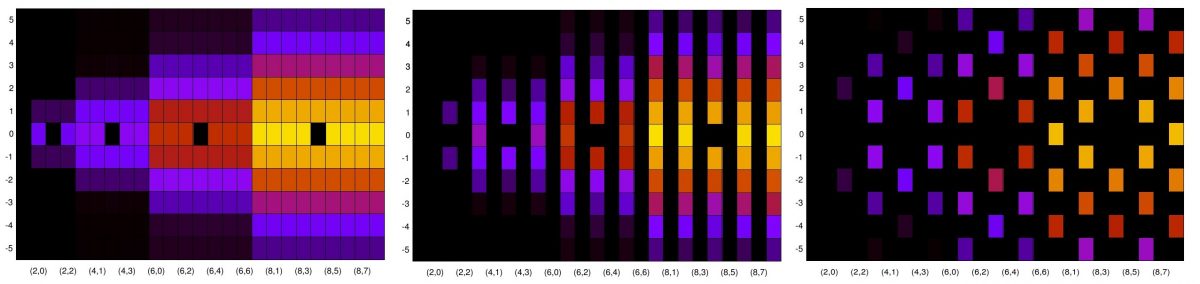
Cyclostationarity of Digital QAM and PSK

PSK and QAM signals form the building blocks for a large number of practical real-world signals. Understanding their probability structure is crucial to understanding those more complicated signals.

Let’s look into the statistical properties of a class of textbook signals that encompasses digital quadrature amplitude modulation (QAM), phase-shift keying (PSK), and pulse-amplitude modulation (PAM). I’ll call the class simply digital QAM (DQAM), and all of its members have an analytical-signal mathematical representation of the form

\displaystyle s(t) = \sum_{k=-\infty}^\infty a_k p(t - kT_0 - t_0) e^{i2\pi f_0 t + i \phi_0}. \hfill  (1)

In this model, k is the symbol index, 1/T_0 = f_{sym} is the symbol rate, f_0 is the carrier frequency (sometimes called the carrier frequency offset), t_0 is the symbol-clock phase, and \phi_0 is the carrier phase. The finite-energy function p(t) is the pulse function (sometimes called the pulse-shaping function). Finally, the random variable a_k is called the symbol, and has a discrete distribution that is called the constellation.

Model (1) is a textbook signal when the sequence of symbols is independent and identically distributed (IID). This condition rules out real-world communication aids such as periodically transmitted bursts of known symbols, adaptive modulation (where the constellation may change in response to the vagaries of the propagation channel), some forms of coding, etc. Also, when the pulse function p(t) is a rectangle (with width T_0), the signal is even less realistic, and therefore more textbooky.

We will look at the moments and cumulants of this general model in this post. Although the model is textbook, we could use it as a building block to form more realistic, less textbooky, signal models. Then we could find the cyclostationarity of those models by applying signal-processing transformation rules that define how the cumulants of the output of a signal processor relate to those for the input.

Continue reading “Cyclostationarity of Digital QAM and PSK”

Signal Processing Operations and CSP

How does the cyclostationarity of a signal change when it is subjected to common signal-processing operations like addition, multiplication, and convolution?

It is often useful to know how a signal processing operation affects the probabilistic parameters of a random signal. For example, if I know the power spectral density (PSD) of some signal x(t), and I filter it using a linear time-invariant transformation with impulse response function h(t), producing the output y(t), then what is the PSD of y(t)? This input-output relationship is well known and quite useful. The relationship is

\displaystyle S_y^0(f) = \left| H(f) \right|^2 S_x^0(f). \hfill (1)

In (1), the function H(f) is the transfer function of the filter, which is the Fourier transform of the impulse-response function h(t).

Because the mathematical models of real-world communication signals can be constructed by subjecting idealized textbook signals to various signal-processing operations, such as filtering, it is of interest to us here at the CSP Blog to know how the spectral correlation function of the output of a signal processor is related to the spectral correlation function for the input. Similarly, we’d like to know such input-output relationships for the cyclic cumulants and the cyclic polyspectra.

Another benefit of knowing these CSP input-output relationships is that they tend to build insight into the meaning of the probabilistic parameters. For example, in the PSD input-output relationship (1), we already know that the transfer function at f = f_0 scales the input frequency component at f_0 by the complex number H(f_0). So it makes sense that the PSD at f_0 is scaled by the squared magnitude of H(f_0). If the filter transfer function is zero at f_0, then the density of averaged power at f_0 should vanish too.

So, let’s look at this kind of relationship for CSP parameters. All of these results can be found, usually with more mathematical detail, in My Papers [6, 13].

Continue reading “Signal Processing Operations and CSP”

Conjugation Configurations

Using complex-valued signal representations is convenient but also has complications: You have to consider all possible choices for conjugating different factors in a moment.

When we considered complex-valued signals and second-order statistics, we ended up with two kinds of parameters: non-conjugate and conjugate. So we have the non-conjugate autocorrelation, which is the expected value of the normal second-order lag product in which only one of the factors is conjugated (consistent with the normal definition of variance for complex-valued random variables),

\displaystyle R_x(t, \boldsymbol{\tau}) = E \left[ x(t+\tau_1)x^*(t+\tau_2) \right] \hfill (1)

and the conjugate autocorrelation, which is the expected value of the second-order lag product in which neither factor is conjugated

\displaystyle R_{x^*}(t, \boldsymbol{\tau}) = E \left[ x(t+\tau_1)x(t+\tau_2) \right]. \hfill (2)

The complex-valued Fourier-series amplitudes of these functions of time t are the non-conjugate and conjugate cyclic autocorrelation functions, respectively.

The Fourier transforms of the non-conjugate and conjugate cyclic autocorrelation functions are the non-conjugate and conjugate spectral correlation functions, respectively.

I never explained the fundamental reason why both the non-conjugate and conjugate functions are needed. In this post, I rectify that omission. The reason for the many different choices of conjugated factors in higher-order cyclic moments and cumulants is also provided. These choices of conjugation configurations, or conjugation patterns, also appear in the more conventional theory of higher-order statistics as applied to stationary signals.

Continue reading “Conjugation Configurations”

Cyclic Temporal Cumulants

Cyclic cumulants are the amplitudes of the Fourier-series components of the time-varying cumulant function for a cyclostationary signal. They degenerate to conventional cumulants when the signal is stationary.

In this post I continue the development of the theory of higher-order cyclostationarity (My Papers [5,6]) that I began here. It is largely taken from my doctoral work (download my dissertation here).

This is a long post. To make it worthwhile, I’ve placed some movies of cyclic-cumulant estimates at the end. Or just skip to the end now if you’re impatient!

In my work on cyclostationary signal processing (CSP), the most useful tools are those for estimating second-order statistics, such as the cyclic autocorrelation, spectral correlation function, and spectral coherence function. However, as we discussed in the post on Textbook Signals, there are some situations (perhaps only academic; see my question in the Textbook post) for which higher-order cyclostationarity is required. In particular, a probabilistic approach to blind modulation recognition for ideal (textbook) digital QAM, PSK, and CPM requires higher-order cyclostationarity because such signals have similar or identical spectral correlation functions and PSDs. (Other high-SNR non-probabilistic approaches can still work, such as blind constellation extraction.)

Recall that in the post introducing higher-order cyclostationarity, I mentioned that one encounters a bit of a puzzle when attempting to generalize experience with second-order cyclostationarity to higher orders. This is the puzzle of pure sine waves (My Papers [5]). Let’s look at pure and impure sine waves, and see how they lead to the probabilistic parameters widely known as cyclic cumulants.

Continue reading “Cyclic Temporal Cumulants”

Introduction to Higher-Order Cyclostationarity

Why do we need or care about higher-order cyclostationarity? Because second-order cyclostationarity is insufficient for our signal-processing needs in some important cases.

We’ve seen how to define second-order cyclostationarity in the time- and frequency-domains, and we’ve looked at ideal and estimated spectral correlation functions for a synthetic rectangular-pulse BPSK signal. In future posts, we’ll look at how to create simple spectral correlation estimators, but in this post I want to introduce the topic of higher-order cyclostationarity (HOCS).  This post is more conceptual in nature; for mathematical details about HOCS, see the posts on cyclic cumulants and cyclic polyspectra. Estimators of higher-order parameters, such as cyclic cumulants and cyclic moments, are discussed in this post.

To contrast with HOCS, we’ll refer to second-order parameters such as the cyclic autocorrelation and the spectral correlation function as parameters of second-order cyclostationarity (SOCS).

The first question we might ask is Why do we care about HOCS? And one answer is that SOCS does not provide all the statistical information about a signal that we might need to perform some signal-processing task. There are two main limitations of SOCS that drive us to HOCS.

Continue reading “Introduction to Higher-Order Cyclostationarity”