SPTK: Linear Time-Invariant Systems

LTI systems, or filters, are everywhere in signal processing. They allow us to adjust the amplitudes and phases of spectral components of the input.

Previous SPTK Post: The Fourier Transform         Next SPTK Post: Frequency Response

In this Signal Processing Toolkit post, we’ll take a first look at arguably the most important class of system models: linear time-invariant (LTI) systems.

What do signal processors and engineers mean by system? Most generally, a system is a rule or mapping that associates one or more input signals to one or more output signals. As we did with signals, we discuss here various useful dichotomies that break up the set of all systems into different subsets with important properties–important to mathematical analysis as well as to design and implementation. Then we’ll look at time-domain input/output relationships for linear systems. In a future post we’ll look at the properties of linear systems in the frequency domain.

Continue reading “SPTK: Linear Time-Invariant Systems”

SPTK: The Fourier Transform

An indispensable tool in CSP and all of signal processing!

Previous SPTK Post: The Fourier Series      Next SPTK Post: Linear Systems

This post in the Signal Processing Toolkit series deals with a key mathematical tool in CSP: The Fourier transform. Let’s try to see how the Fourier transform arises from a limiting version of the Fourier series.

Continue reading “SPTK: The Fourier Transform”

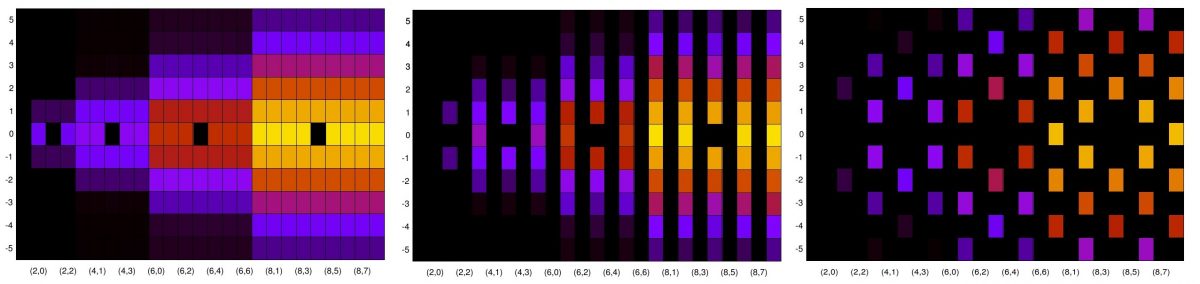
Symmetries of Higher-Order Temporal Probabilistic Parameters in CSP

What are the unique parts of the multidimensional cyclic moments and cyclic cumulants?

In this post, we continue our study of the symmetries of CSP parameters. The second-order parameters–spectral correlation and cyclic correlation–are covered in detail in the companion post, including the symmetries for ‘auto’ and ‘cross’ versions of those parameters.

Here we tackle the generalizations of cyclic correlation: cyclic temporal moments and cumulants. We’ll deal with the generalization of the spectral correlation function, the  cyclic polyspectra, in a subsequent post. It is reasonable to me to focus first on the higher-order temporal parameters, because I consider the temporal parameters to be much more useful in practice than the spectral parameters.

This topic is somewhat harder and more abstract than the second-order topic, but perhaps there are bigger payoffs in algorithm development for exploiting symmetries in higher-order parameters than in second-order parameters because the parameters are multidimensional. So it could be worthwhile to sally forth.

Continue reading “Symmetries of Higher-Order Temporal Probabilistic Parameters in CSP”

SPTK: The Fourier Series

A crucial tool for developing the temporal parameters of CSP.

Previous SPTK Post: Signal Representations            Next SPTK Post: The Fourier Transform

This installment of the Signal Processing Toolkit shows how the Fourier series arises from a consideration of representing arbitrary signals as vectors in a signal space. We also provide several examples of Fourier-series calculations, interpret the Fourier series, and discuss its relevance to cyclostationary signal processing.

Continue reading “SPTK: The Fourier Series”