SPTK: The Characteristic Function

The collision of probability, Fourier analysis, and communication-signal models.

Previous SPTK Post: I and Q Next SPTK Post: The Matched Filter

Let’s return to the probability section of the Signal Processing ToolKit posts with a look at the characteristic function, which is the Fourier transform of the probability density function. We will see it has a deep connection to the central mathematical entities of CSP, which are moments and cumulants.

Continue reading “SPTK: The Characteristic Function”

CSP Reduction to Sine-Wave Generation

“Five different voices behind him bellowed, “REDUCTO!” Five curses flew in five different directions and the shelves opposite them exploded as they hit; the towering structure swayed as a hundred glass spheres burst apart, pearly-white figures unfurled into the air and floated there, their voices echoing from who knew what long-dead past amid the torrent of crashing glass and splintered wood now raining down upon the floor…”

J. K. Rowling, Harry Potter and the Order of the Phoenix

We know that if we subject a cyclostationary signal to a squaring or delay-and-multiply operation we will obtain finite-strength additive sine-wave components at the output of the operation, where at least one of the sine waves has a non-zero frequency.

But I want to make a conjecture: All of CSP can be reduced to interpretations involving sine-wave generation by nonlinear operations. Let’s see if we can show this conjecture is true. After I make my attempt, I’ll also show what ChatGPT comes up with. Any guesses about how well it does?

Continue reading “CSP Reduction to Sine-Wave Generation”

Interference Mitigation Course at GTRI

Update December 2024: The likely date for this course at GTRI is February 4-5, 2025.

Update September 2024: This course is postponed until Spring 2025. I’ll post further updates here as they become available.


I’ll be part of a team of researchers and practicing engineers, led by the estimable Dr. Ryan Westafer, that will be teaching a class on radio-frequency interference mitigation in September. The class is hosted by the Georgia Tech Research Institute (GTRI) and will be held on the Georgia Tech campus on September 10-11, 2024.

Continue reading “Interference Mitigation Course at GTRI”

Final Snoap Doctoral-Work Journal Paper: My Papers [56] on Novel Network Layers for Modulation Recognition that Generalizes

Dr. Snoap’s final journal paper related to his recently completed doctoral work has been published in IEEE Transactions on Broadcasting (My Papers [56]).

Continue reading “Final Snoap Doctoral-Work Journal Paper: My Papers [56] on Novel Network Layers for Modulation Recognition that Generalizes”

Desultory CSP: What’s That Under the TV?

“Alive in the Superunknown
First it steals your Mind, and then it steals your … Soul”

–Soundgarden

An advantage of using and understanding the statistics of communication signals ™, the basics of signal processing, and the rich details of cyclostationary signal processing is that a practitioner can deal with, to some useful degree, unknown unknowns. The unknown unknowns I’m talking about here on the CSP Blog are, of course, signals. We know about the by-now-familiar known-type detection, multi-class modulation-recognition, and RF scene-analysis problems, in which it is often assumed that we know the signals we are looking for, but we don’t know their times of arrival, some of their parameters, or how they might overlap in time, frequency, and space. Then there are the less-familiar problems involving unknown unknowns.

Sometimes we just don’t know the signals we are looking for. We still want to do as good a job on RF scene analysis as we can, but there might be signals in the scene that do not conform to the body of knowledge we have, to date, of manmade RF signals. Or, in modern parlance, we didn’t even know we left such signals out of our neural-network training dataset; we’re a couple steps back from even worrying about generalization, because we don’t even know we can’t generalize since we are ignorant about what to generalize to.

In this post I look at the broadcast TV band, seen in downtown Monterey, California, sometime in the recent past. I expect to see ATSC DTV signals (of the older 8VSB/16VSB or the newer OFDM types), and I do. But what else is there? Spoiler: Unknown unknowns.

Let’s take a look.

Continue reading “Desultory CSP: What’s That Under the TV?”
CSPB.ML.2023G1

Another dataset aimed at the continuing problem of generalization in machine-learning-based modulation recognition. This one is a companion to CSPB.ML.2023, which features cochannel situations.

Quality datasets containing digital signals with varied parameters and lengths sufficient to permit many kinds of validation checks by signal-processing experts remain in short supply. In this post, we continue our efforts to provide such datasets by offering a companion unlabeled dataset to CSPB.ML.2023.

Continue reading “CSPB.ML.2023G1”

CSPB.ML.2018R2: Correcting an RNG Flaw in CSPB.ML.2018

KIRK: Everything that is in error must be sterilised.
NOMAD: There are no exceptions.
KIRK: Nomad, I made an error in creating you.
NOMAD: The creation of perfection is no error.
KIRK: I did not create perfection. I created error.

I’ve had to update the original Challenge for the Machine Learners post, and the associated dataset post, a couple times due to flaws in my metadata (truth) files. Those were fairly minor, so I just updated the original posts.

But a new flaw in CSPB.ML.2018 and CSPB.ML.2022 has come to light due to the work of the estimable research engineers at Expedition Technology. The problem is not with labeling or the fundamental correctness of the modulation types, pulse functions, etc., but with the way a random-number generator was applied in my multi-threaded dataset-generation technique.

I’ll explain after the fold, and this post will provide links to an updated version of the dataset, CSPB.ML.2018R2. I’ll keep the original up for continuity and also place a link to this post there. Moreover, the descriptions of the truth files over at CSPB.ML.2018 are still valid–the truth file posted here has the same format as the truth files available on the CSPB.ML.2018 and CSPB.ML.2022 posts.

Continue reading “CSPB.ML.2018R2: Correcting an RNG Flaw in CSPB.ML.2018”

The Next Logical Step in CSP+ML for Modulation Recognition: Snoap’s MILCOM ’23 Paper [Preview]

We are attempting to force a neural network to learn the features that we have already shown deliver simultaneous good performance and good generalization.

ODU doctoral student John Snoap and I have a new paper on the convergence of cyclostationary signal processing, machine learning using trained neural networks, and RF modulation classification: My Papers [55] (arxiv.org link here).

Previously in My Papers [50-52, 54] we have shown that the (multitudinous!) neural networks in the literature that use I/Q data as input and perform modulation recognition (output a modulation-class label) are highly brittle. That is, they minimize the classification error, they converge, but they don’t generalize. A trained neural network generalizes well if it can maintain high classification performance even if some of the probability density functions for the data’s random variables differ from the training inputs (in the lab) relative to the application inputs (in the field). The problem is also called the dataset-shift problem or the domain-adaptation problem. Generalization is my preferred term because it is simpler and has a strong connection to the human equivalent: we can quite easily generalize our observations and conclusions from one dataset to another without massive retraining of our neural noggins. We can find the cat in the image even if it is upside-down and colored like a giraffe.

Continue reading “The Next Logical Step in CSP+ML for Modulation Recognition: Snoap’s MILCOM ’23 Paper [Preview]”

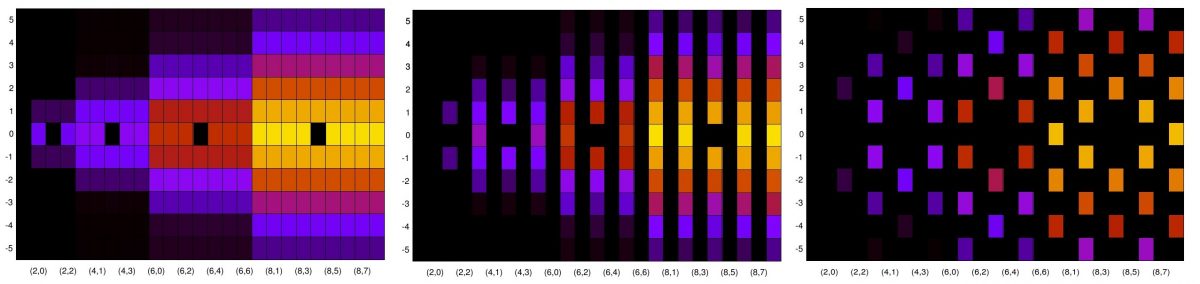
A Gallery of Cyclic Cumulants

The third in a series of posts on visualizing the multidimensional functions characterizing the fundamental statistics of communication signals.

Let’s continue our progression of galleries showing plots of the statistics of communication signals. So far we have provided a gallery of spectral correlation surfaces and a gallery of cyclic autocorrelation surfaces. Here we introduce a gallery of cyclic-cumulant matrices.

When we look at the spectral correlation or cyclic autocorrelation surfaces for a variety of communication signal types, we learn that the cycle-frequency patterns exhibited by modulated signals are many and varied, and we get a feeling for how those variations look (see also the Desultory CSP posts). Nevertheless, there are large equivalence classes in terms of spectral correlation. That simply means that a large number of distinct modulation types map to the exact same second-order statistics, and therefore to the exact same spectral correlation and cyclic autocorrelation surfaces. The gallery of cyclic cumulants will reveal, in an easy-to-view way, that many of these equivalence classes are removed once we consider, jointly, both second- and higher-order statistics.

Continue reading “A Gallery of Cyclic Cumulants”

Latest Paper on CSP and Deep-Learning for Modulation Recognition: An Extended Version of My Papers [52]

Another step forward in the merging of CSP and ML for modulation recognition, and another step away from the misstep of always relying on convolutional neural networks from image processing for RF-domain problem-solving.

My Old Dominion colleagues and I have published an extended version of the 2022 MILCOM paper My Papers [52] in the journal MDPI Sensors. The first author is John Snoap, who is one of those rare people that is an expert in signal processing and in machine learning. Bright future there! Dimitrie Popescu, James Latshaw, and I provided analysis, programming, writing, and research-direction support.

Continue reading “Latest Paper on CSP and Deep-Learning for Modulation Recognition: An Extended Version of My Papers [52]”

Cyclostationarity of Frequency-Shift-Keyed Signals

The cyclostationarity of frequency-shift-keyed signals depends strongly on the way the carrier phase evolves over time. Many distinct cycle-frequency patterns and spectral correlation shapes are possible.

Let’s get back to basics by looking at a large class of signals known as frequency-shift-keyed (FSK) signals. We will leave to the side, for the most part, the very large class of signals that goes by the name of continuous-phase modulation (CPM), which includes continuous-phase FSK (CPFSK), MSK, GMSK, and many more (The Literature [R188]-[R190]). Those are treated in My Papers [8], and in a future CSP Blog post.

Here we want to look at more conventional forms of FSK. These signal types don’t necessarily have a continuous phase function. They are generally easier to demodulate and are more robust to noise and interference than the more complicated CPM signal types, but generally have much lower spectral efficiency. They are like the rectangular-pulse PSK of the FSK/CPM world. But they are still used.

Continue reading “Cyclostationarity of Frequency-Shift-Keyed Signals”

Is Radio-Frequency Scene Analysis a Wicked Problem?

‘By the pricking of my thumbs, something wicked this way comes …’ Macbeth by W. Shakespeare

I attended a conference on dynamic spectrum access in 2017 and participated in a session on automatic modulation recognition. The session was connected to a live competition within the conference where participants would attempt to apply their modulation-recognition system to signals transmitted in the conference center by the conference organizers. Like a grand modulation-recognition challenge but confined to the temporal, spectral, and spatial constraints imposed by the short-duration conference.

What I didn’t know going in was the level of frustration on the part of the machine-learner organizers regarding the seeming inability of signal-processing and machine-learning researchers to solve the radio-frequency scene analysis problem once and for all. The basic attitude was ‘if the image-processors can have the AlexNet image-recognition solution, and thereby abandon their decades-long attempt at developing serious mathematics-based image-processing theory and practice, why haven’t we solved the RFSA problem yet?’

Continue reading “Is Radio-Frequency Scene Analysis a Wicked Problem?”

Frequency Shift (FRESH) Filtering for Single-Sensor Cochannel Signal Separation

CSP can be used to separate cochannel contemporaneous signals. The involved signal-processing structure is linear but periodically time-varying.

In most of the posts on the CSP Blog we’ve applied the theory and tools of CSP to parameter estimation of one sort or another: cycle-frequency estimation, time-delay estimation, synchronization-parameter estimation, and of course estimation of the spectral correlation, spectral coherence, cyclic cumulant, and cyclic polyspectral functions.

In this post, we’ll switch gears a bit and look at the problem of waveform estimation. This comes up in two situations for me: single-sensor processing and array (multi-sensor) processing. At some point, I’ll write a post on array processing for waveform estimation (using, say, the SCORE algorithm The Literature [R102]), but here we restrict our attention to the case of waveform estimation using only a single sensor (a single antenna connected to a single receiver). We just have one observed sampled waveform to work with. There are also waveform estimation methods that are multi-sensor but not typically referred to as array processing, such as the blind source separation problem in acoustic scene analysis, which is often solved by principal component analysis (PCA), independent component analysis (ICA), and their variants.

The signal model consists of the noisy sum of two or more modulated waveforms that overlap in both time and frequency. If the signals do not overlap in time, then we can separate them by time gating, and if they do not overlap in frequency, we can separate them using linear time-invariant systems (filters).

Relevant FRESH filtering publications include My Papers [45, 46] and The Literature [R6].

Continue reading “Frequency Shift (FRESH) Filtering for Single-Sensor Cochannel Signal Separation”

PSK/QAM Cochannel Dataset for Modulation Recognition Researchers [CSPB.ML.2023]

The next step in dataset complexity at the CSP Blog: cochannel signals.

I’ve developed another dataset for use in assessing modulation-recognition algorithms (machine-learning-based or otherwise) that is more complex than the original sets I posted for the ML Challenge (CSPB.ML.2018 and CSPB.ML.2022). Half of the new dataset consists of one signal in noise and the other half consists of two signals in noise. In most cases the two signals overlap spectrally, which is a signal condition called cochannel interference.

We’ll call it CSPB.ML.2023.

Continue reading “PSK/QAM Cochannel Dataset for Modulation Recognition Researchers [CSPB.ML.2023]”

ICARUS: More on Attempts to Merge IQ Data with Extracted-Feature Data in Machine Learning

How can we train a neural network to make use of both IQ data samples and CSP features in the context of weak-signal detection?

I’ve been working with some colleagues at Northeastern University (NEU) in Boston, MA, on ways to combine CSP with machine learning. The work I’m doing with Old Dominion University is focused on basic modulation recognition using neural networks and, in particular, the generalization (dataset-shift) problem that is pervasive in deep learning with convolution neural networks. In contrast, the NEU work is focused on specific signal detection and classification problems and looks at how to use multiple disparate data types as inputs to neural-networks; inputs such as complex-valued samples (IQ data) as well as carefully selected components of spectral correlation and spectral coherence surfaces.

My NEU colleagues and I will be publishing a rather lengthy conference paper on a new multi-input-data neural-network approach called ICARUS at InfoCom 2023 this May (My Papers [53]). You can get a copy of the pre-publication version here or on arxiv.org.

Continue reading “ICARUS: More on Attempts to Merge IQ Data with Extracted-Feature Data in Machine Learning”

Correcting the Record: Comments On “Wireless Signal Representation Techniques for Automatic Modulation Classification,” by X. Liu et al

It’s too close to home, and it’s too near the bone …

Park the car at the side of the road
You should know
Time’s tide will smother you…
And I will too

“That Joke Isn’t Funny Anymore” by The Smiths

I applaud the intent behind the paper in this post’s title, which is The Literature [R183], apparently accepted in 2022 for publication in IEEE Access, a peer-reviewed journal. That intent is to list all the found ways in which researchers preprocess radio-frequency data (complex sampled data) prior to applying some sort of modulation classification (recognition) algorithm or system.

The problem is that this attempt at gathering up all of the ‘representations’ gets a lot of the math wrong, and so has a high potential to confuse rather than illuminate.

There’s only one thing to do: correct the record.

Continue reading “Correcting the Record: Comments On “Wireless Signal Representation Techniques for Automatic Modulation Classification,” by X. Liu et al”

Some Concrete Results on Generalization in Modulation Recognition using Machine Learning

Neural networks with I/Q data as input do not generalize in the modulation-recognition problem setting.

Update May 20, 2022: Here is the arxiv.org link.

Back in 2018 I posted a dataset consisting of 112,000 I/Q data files, 32,768 samples in length each, as a part of a challenge to machine learners who had been making strong claims of superiority over signal processing in the area of automatic modulation recognition. One part of the challenge was modulation recognition involving eight digital modulation types, and the other was estimating the carrier frequency offset. That dataset is described here, and I’d like to refer to it as CSPB.ML.2018.

Then in 2022 I posted a companion dataset to CSPB.ML.2018 called CSPB.ML.2022. This new dataset uses the same eight modulation types, similar ranges of SNR, pulse type, and symbol rate, but the random variable that governs the carrier frequency offset is different with respect to the random variable in CSPB.ML.2018. The purpose of the CSPB.ML.2022 dataset is to facilitate studies of the dataset-shift, or generalization, problem in machine learning.

Throughout the past couple of years I’ve been working with some graduate students and a professor at Old Dominion University on merging machine learning and signal processing for problems involving RF signal analysis, such as modulation recognition. We are starting to publish a sequence of papers that describe our efforts. I briefly describe the results of one such paper, My Papers [51], in this post.

Continue reading “Some Concrete Results on Generalization in Modulation Recognition using Machine Learning”

Wow, Elsevier, Just … Wow. Comments On “Cyclic Correntropy: Properties and the Application in Symbol Rate Estimation Under Alpha-Stable Distributed Noise,” by S. Luan et al.

Can we fix peer review in engineering by some form of payment to reviewers?

Let’s talk about another paper about cyclostationarity and correntropy. I’ve critically reviewed two previously, which you can find here and here. When you look at the correntropy as applied to a cyclostationary signal, you get something called cyclic correntropy, which is not particularly useful except if you don’t understand regular cyclostationarity and some aspects of garden-variety signal processing. Then it looks great.

But this isn’t a post that primarily takes the authors of a paper to task, although it does do that. I want to tell the tale to get us thinking about what ‘peer’ could mean, these days, in ‘peer-reviewed paper.’ How do we get the best peers to review our papers?

Let’s take a look at The Literature [R173].

Continue reading “Wow, Elsevier, Just … Wow. Comments On “Cyclic Correntropy: Properties and the Application in Symbol Rate Estimation Under Alpha-Stable Distributed Noise,” by S. Luan et al.”

Update on J. Antoni’s Fast Spectral Correlation Estimator

Let’s take a look at an even faster spectral correlation function estimator. How useful is it for CSP applications in communications?

Reader Gideon pointed out that Antoni had published a paper a year after the paper that I considered in my first Antoni post. This newer paper, The Literature [R172], promises a faster fast spectral correlation estimator, and it delivers on that according to the analysis in the paper. However, I think the faster fast spectral correlation estimator is just as limited as the slower fast spectral correlation estimator when considered in the context of communication-signal processing.

And, to be fair, Antoni doesn’t often consider the context of communication-signal processing. His favored application is fault detection in mechanical systems with rotating parts. But I still don’t think the way he compares his fast and faster estimators to conventional estimators is fair. The reason is that his estimators are both severely limited in the maximum cycle frequency that can be processed, relative to the maximum cycle frequency that is possible.

Let’s take a look.

Continue reading “Update on J. Antoni’s Fast Spectral Correlation Estimator”

Shifted Dataset for the Machine-Learning Challenge: How Well Does a Modulation-Recognition DNN Generalize? [Dataset CSPB.ML.2022]

Another RF-signal dataset to help push along our R&D on modulation recognition.

Update October 2023: A flaw in the way a random-number generator was used to create CSPB.ML.2022 (and CSPB.ML.2018) has led me to recreate the dataset and post it here. It is called CSPB.ML.2022R2.

Update February 2023: A third dataset has been posted to the CSP Blog: CSPB.ML.2023. It features cochannel signals.

Update January 2023: I’m going to put Challenger results in the Comments. I’ve received a Challenger’s decisions and scored them in January 2023. See below.

In this post I provide a second dataset for the Machine-Learning Challenge I issued in 2018 (CSPB.ML.2018). This dataset is similar to the original dataset, but possesses a key difference in that the probability distribution of the carrier-frequency offset parameter, viewed as a random variable, is not the same, but is still realistic.

Blog Note: By WordPress’ count, this is the 100th post on the CSP Blog. Together with a handful of pages (like My Papers and The Literature), these hundred posts have resulted in about 250,000 page views. That’s an average of 2,500 page views per post. However, the variance of the per-post pageviews is quite large. The most popular is The Spectral Correlation Function (> 16,000) while the post More on Pure and Impure Sinewaves, from the same era, has only 316 views. A big Thanks to all my readers!!

Continue reading “Shifted Dataset for the Machine-Learning Challenge: How Well Does a Modulation-Recognition DNN Generalize? [Dataset CSPB.ML.2022]”