SPTK: The Characteristic Function

The collision of probability, Fourier analysis, and communication-signal models.

Previous SPTK Post: I and Q Next SPTK Post: The Matched Filter

Let’s return to the probability section of the Signal Processing ToolKit posts with a look at the characteristic function, which is the Fourier transform of the probability density function. We will see it has a deep connection to the central mathematical entities of CSP, which are moments and cumulants.

Continue reading “SPTK: The Characteristic Function”

Final Snoap Doctoral-Work Journal Paper: My Papers [56] on Novel Network Layers for Modulation Recognition that Generalizes

Dr. Snoap’s final journal paper related to his recently completed doctoral work has been published in IEEE Transactions on Broadcasting (My Papers [56]).

Continue reading “Final Snoap Doctoral-Work Journal Paper: My Papers [56] on Novel Network Layers for Modulation Recognition that Generalizes”

The Next Logical Step in CSP+ML for Modulation Recognition: Snoap’s MILCOM ’23 Paper [Preview]

We are attempting to force a neural network to learn the features that we have already shown deliver simultaneous good performance and good generalization.

ODU doctoral student John Snoap and I have a new paper on the convergence of cyclostationary signal processing, machine learning using trained neural networks, and RF modulation classification: My Papers [55] (arxiv.org link here).

Previously in My Papers [50-52, 54] we have shown that the (multitudinous!) neural networks in the literature that use I/Q data as input and perform modulation recognition (output a modulation-class label) are highly brittle. That is, they minimize the classification error, they converge, but they don’t generalize. A trained neural network generalizes well if it can maintain high classification performance even if some of the probability density functions for the data’s random variables differ from the training inputs (in the lab) relative to the application inputs (in the field). The problem is also called the dataset-shift problem or the domain-adaptation problem. Generalization is my preferred term because it is simpler and has a strong connection to the human equivalent: we can quite easily generalize our observations and conclusions from one dataset to another without massive retraining of our neural noggins. We can find the cat in the image even if it is upside-down and colored like a giraffe.

Continue reading “The Next Logical Step in CSP+ML for Modulation Recognition: Snoap’s MILCOM ’23 Paper [Preview]”

A Gallery of Cyclic Cumulants

The third in a series of posts on visualizing the multidimensional functions characterizing the fundamental statistics of communication signals.

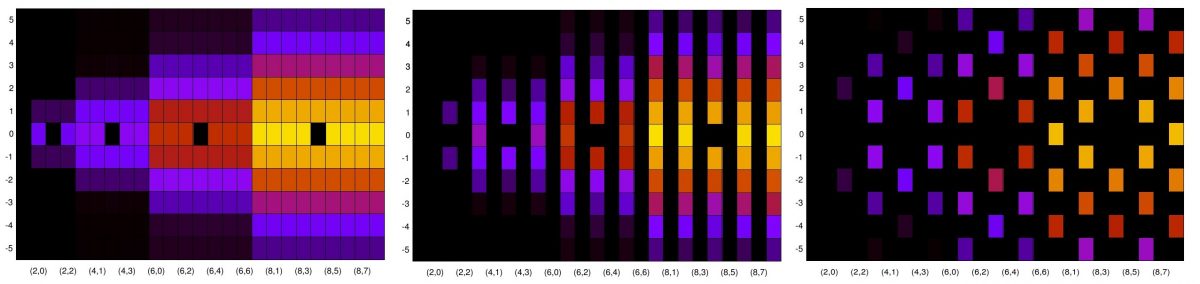
Let’s continue our progression of galleries showing plots of the statistics of communication signals. So far we have provided a gallery of spectral correlation surfaces and a gallery of cyclic autocorrelation surfaces. Here we introduce a gallery of cyclic-cumulant matrices.

When we look at the spectral correlation or cyclic autocorrelation surfaces for a variety of communication signal types, we learn that the cycle-frequency patterns exhibited by modulated signals are many and varied, and we get a feeling for how those variations look (see also the Desultory CSP posts). Nevertheless, there are large equivalence classes in terms of spectral correlation. That simply means that a large number of distinct modulation types map to the exact same second-order statistics, and therefore to the exact same spectral correlation and cyclic autocorrelation surfaces. The gallery of cyclic cumulants will reveal, in an easy-to-view way, that many of these equivalence classes are removed once we consider, jointly, both second- and higher-order statistics.

Continue reading “A Gallery of Cyclic Cumulants”

Latest Paper on CSP and Deep-Learning for Modulation Recognition: An Extended Version of My Papers [52]

Another step forward in the merging of CSP and ML for modulation recognition, and another step away from the misstep of always relying on convolutional neural networks from image processing for RF-domain problem-solving.

My Old Dominion colleagues and I have published an extended version of the 2022 MILCOM paper My Papers [52] in the journal MDPI Sensors. The first author is John Snoap, who is one of those rare people that is an expert in signal processing and in machine learning. Bright future there! Dimitrie Popescu, James Latshaw, and I provided analysis, programming, writing, and research-direction support.

Continue reading “Latest Paper on CSP and Deep-Learning for Modulation Recognition: An Extended Version of My Papers [52]”

ChatGPT and CSP

Am I out of a job?

Update January 31, 2023: I’ve added numbers in square brackets next to the worst of the wrong things. I’ll document the errors at the bottom of the post.


Of course I have to see what ChatGPT has to say about CSP. Including definitions, which I don’t expect it to get too wrong, and code for estimators, which I expect it to get very wrong.

Let’s take a look.

Continue reading “ChatGPT and CSP”

Correcting the Record: Comments On “Wireless Signal Representation Techniques for Automatic Modulation Classification,” by X. Liu et al

It’s too close to home, and it’s too near the bone …

Park the car at the side of the road
You should know
Time’s tide will smother you…
And I will too

“That Joke Isn’t Funny Anymore” by The Smiths

I applaud the intent behind the paper in this post’s title, which is The Literature [R183], apparently accepted in 2022 for publication in IEEE Access, a peer-reviewed journal. That intent is to list all the found ways in which researchers preprocess radio-frequency data (complex sampled data) prior to applying some sort of modulation classification (recognition) algorithm or system.

The problem is that this attempt at gathering up all of the ‘representations’ gets a lot of the math wrong, and so has a high potential to confuse rather than illuminate.

There’s only one thing to do: correct the record.

Continue reading “Correcting the Record: Comments On “Wireless Signal Representation Techniques for Automatic Modulation Classification,” by X. Liu et al”

Some Concrete Results on Generalization in Modulation Recognition using Machine Learning

Neural networks with I/Q data as input do not generalize in the modulation-recognition problem setting.

Update May 20, 2022: Here is the arxiv.org link.

Back in 2018 I posted a dataset consisting of 112,000 I/Q data files, 32,768 samples in length each, as a part of a challenge to machine learners who had been making strong claims of superiority over signal processing in the area of automatic modulation recognition. One part of the challenge was modulation recognition involving eight digital modulation types, and the other was estimating the carrier frequency offset. That dataset is described here, and I’d like to refer to it as CSPB.ML.2018.

Then in 2022 I posted a companion dataset to CSPB.ML.2018 called CSPB.ML.2022. This new dataset uses the same eight modulation types, similar ranges of SNR, pulse type, and symbol rate, but the random variable that governs the carrier frequency offset is different with respect to the random variable in CSPB.ML.2018. The purpose of the CSPB.ML.2022 dataset is to facilitate studies of the dataset-shift, or generalization, problem in machine learning.

Throughout the past couple of years I’ve been working with some graduate students and a professor at Old Dominion University on merging machine learning and signal processing for problems involving RF signal analysis, such as modulation recognition. We are starting to publish a sequence of papers that describe our efforts. I briefly describe the results of one such paper, My Papers [51], in this post.

Continue reading “Some Concrete Results on Generalization in Modulation Recognition using Machine Learning”

Shifted Dataset for the Machine-Learning Challenge: How Well Does a Modulation-Recognition DNN Generalize? [Dataset CSPB.ML.2022]

Another RF-signal dataset to help push along our R&D on modulation recognition.

Update October 2023: A flaw in the way a random-number generator was used to create CSPB.ML.2022 (and CSPB.ML.2018) has led me to recreate the dataset and post it here. It is called CSPB.ML.2022R2.

Update February 2023: A third dataset has been posted to the CSP Blog: CSPB.ML.2023. It features cochannel signals.

Update January 2023: I’m going to put Challenger results in the Comments. I’ve received a Challenger’s decisions and scored them in January 2023. See below.

In this post I provide a second dataset for the Machine-Learning Challenge I issued in 2018 (CSPB.ML.2018). This dataset is similar to the original dataset, but possesses a key difference in that the probability distribution of the carrier-frequency offset parameter, viewed as a random variable, is not the same, but is still realistic.

Blog Note: By WordPress’ count, this is the 100th post on the CSP Blog. Together with a handful of pages (like My Papers and The Literature), these hundred posts have resulted in about 250,000 page views. That’s an average of 2,500 page views per post. However, the variance of the per-post pageviews is quite large. The most popular is The Spectral Correlation Function (> 16,000) while the post More on Pure and Impure Sinewaves, from the same era, has only 316 views. A big Thanks to all my readers!!

Continue reading “Shifted Dataset for the Machine-Learning Challenge: How Well Does a Modulation-Recognition DNN Generalize? [Dataset CSPB.ML.2022]”

Are Probability Density Functions “Engineered” or “Hand-Crafted” Features?

The Machine Learners think that their “feature engineering” (rooting around in voluminous data) is the same as “features” in mathematically derived signal-processing algorithms. I take a lighthearted look.

One of the things the machine learners never tire of saying is that their neural-network approach to classification is superior to previous methods because, in part, those older methods use hand-crafted features. They put it in different ways, but somewhere in the introductory section of a machine-learning modulation-recognition paper (ML/MR), you’ll likely see the claim. You can look through the ML/MR papers I’ve cited in The Literature ([R133]-[R146]) if you are curious, but I’ll extract a couple here just to illustrate the idea.

Continue reading “Are Probability Density Functions “Engineered” or “Hand-Crafted” Features?”

Stationary Signal Models Versus Cyclostationary Signal Models

What happens when a cyclostationary time-series is treated as if it were stationary?

In this post let’s consider the difference between modeling a communication signal as stationary or as cyclostationary.

There are two contexts for this kind of issue. The first is when someone recognizes that a particular signal model is cyclostationary, and then takes some action to render it stationary (sometimes called ‘stationarizing the signal’). They then proceed with their analysis or algorithm development using the stationary signal model. The second context is when someone applies stationary-signal processing to a cyclostationary signal model, either without knowing that the signal is cyclostationary, or perhaps knowing but not caring.

At the center of this topic is the difference between the mathematical object known as a random process (or stochastic process) and the mathematical object that is a single infinite-time function (or signal or time-series).

A related paper is The Literature [R68], which discusses the pitfalls of applying tools meant for stationary signals to the samples of cyclostationary signals.

Continue reading “Stationary Signal Models Versus Cyclostationary Signal Models”

Symmetries of Higher-Order Temporal Probabilistic Parameters in CSP

What are the unique parts of the multidimensional cyclic moments and cyclic cumulants?

In this post, we continue our study of the symmetries of CSP parameters. The second-order parameters–spectral correlation and cyclic correlation–are covered in detail in the companion post, including the symmetries for ‘auto’ and ‘cross’ versions of those parameters.

Here we tackle the generalizations of cyclic correlation: cyclic temporal moments and cumulants. We’ll deal with the generalization of the spectral correlation function, the  cyclic polyspectra, in a subsequent post. It is reasonable to me to focus first on the higher-order temporal parameters, because I consider the temporal parameters to be much more useful in practice than the spectral parameters.

This topic is somewhat harder and more abstract than the second-order topic, but perhaps there are bigger payoffs in algorithm development for exploiting symmetries in higher-order parameters than in second-order parameters because the parameters are multidimensional. So it could be worthwhile to sally forth.

Continue reading “Symmetries of Higher-Order Temporal Probabilistic Parameters in CSP”

Symmetries of Second-Order Probabilistic Parameters in CSP

Do we need to consider all cycle frequencies, both positive and negative? Do we need to consider all delays and frequencies in our second-order CSP parameters?

As you progress through the various stages of learning CSP (intimidation, frustration, elucidation, puzzlement, and finally smooth operation), the symmetries of the various functions come up over and over again. Exploiting symmetries can result in lower computational costs, quicker debugging, and easier mathematical development.

What exactly do we mean by ‘symmetries of parameters?’ I’m talking primarily about the evenness or oddness of the time-domain functions in the delay \tau and cycle frequency \alpha variables and of the frequency-domain functions in the spectral frequency f and cycle frequency \alpha variables. Or a generalized version of evenness/oddness, such as f(-x) = g(x), where f(x) and g(x) are closely related functions. We have to consider the non-conjugate and conjugate functions separately, and we’ll also consider both the auto and cross versions of the parameters. We’ll look at higher-order cyclic moments and cumulants in a future post.

You can use this post as a resource for mathematical development because I present the symmetry equations. But also each symmetry result is illustrated using estimated parameters via the frequency smoothing method (FSM) of spectral correlation function estimation. The time-domain parameters are obtained from the inverse transforms of the FSM parameters. So you can also use this post as an extension of the second-order verification guide to ensure that your estimator works for a wide variety of input parameters.

Continue reading “Symmetries of Second-Order Probabilistic Parameters in CSP”

Dataset for the Machine-Learning Challenge [CSPB.ML.2018]

A PSK/QAM/SQPSK data set with randomized symbol rate, inband SNR, carrier-frequency offset, and pulse roll-off.

Update April 2025: All but the first five batch files have been removed. I needed to make space since WordPress has a hard limit on storage. Use CSPB.ML.2018R2 in any case.

Update September 2023: A randomization flaw has been found and fixed for CSPB.ML.2018, resulting in CSPB.ML.2018R2. Use that one going forward.

Update February 2023: I’ve posted a third challenge dataset here. It is CSPB.ML.2023 and features cochannel signals.

Update April 2022. I’ve also posted a second dataset here. This new dataset is similar to the original ML Challenge dataset except the random variable representing the carrier frequency offset has a slightly different distribution.

If you refer to either of the posted datasets in a published paper, please use the following designators, which I am also using in papers I’m attempting to publish:

Original ML Challenge Dataset: CSPB.ML.2018.

Shifted ML Challenge Dataset: CSPB.ML.2022.

Update September 2020. I made a mistake when I created the signal-parameter “truth” files signal_record.txt and signal_record_first_20000.txt. Like the DeepSig RML datasets that I analyzed on the CSP Blog here and here, the SNR parameter in the truth files did not match the actual SNR of the signals in the data files. I’ve updated the truth files and the links below. You can still use the original files for all other signal parameters, but the SNR parameter was in error.

Update July 2020. I originally posted 20,000 signals in the posted dataset. I’ve now added another 92,000 for a total of 112,000 signals. The original signals are contained in Batches 1-5, the additional signals in Batches 6-28. I’ve placed these additional Batches at the end of the post to preserve the original post’s content.

Continue reading “Dataset for the Machine-Learning Challenge [CSPB.ML.2018]”
How we Learned CSP

We learned it using abstractions involving various infinite quantities. Can a machine learn it without that advantage?

This post is just a blog post. Just some guy on the internet thinking out loud. If you have relevant thoughts or arguments you’d like to advance, please leave them in the Comments section at the end of the post.

How did we, as people not machines, learn to do cyclostationary signal processing? We’ve successfully applied it to many real-world problems, such as weak-signal detection, interference-tolerant detection, interference-tolerant time-delay estimation, modulation recognition, joint multiple-cochannel-signal modulation recognition (My Papers [25,26,28,38,43]), synchronization (The Literature [R7]), beamforming (The Literature [R102,R103]), direction-finding (The Literature [R104-R106]), detection of imminent mechanical failures (The Literature [R017-R109]), linear time-invariant system identification (The Literature [R110-R115]), and linear periodically time-variant filtering for cochannel signal separation (FRESH filtering) (My Papers [45], The Literature [R6]).

How did this come about? Is it even interesting to ask the question? Well, it is to me. I ask it because of the current hot topic in signal processing: machine learning. And in particular, machine learning applied to modulation recognition (see here and here and here and here). The machine learners want to capitalize on the success of machine learning as applied to image recognition by directly applying the same sorts of image-recognition techniques to the problem of automatic type-recognition for human-made electromagnetic waves.

Continue reading “How we Learned CSP”

A Challenge for the Machine Learners

The machine-learning modulation-recognition community consistently claims vastly superior performance to anything that has come before. Let’s test that.

Update September 2023: A randomization flaw has been found and fixed for CSPB.ML.2018, resulting in CSPB.ML.2018R2. Use that one going forward.

Update February 2023: A third dataset has been posted here. This new dataset, CSPB.ML.2023, features cochannel signals.

Update April 2022: I’ve also posted a second dataset here. This new dataset is similar to the original ML Challenge dataset except the random variable representing the carrier frequency offset has a slightly different distribution.

If you refer to any of the posted datasets in a published paper, please use the following designators, which I am also using in papers I’m attempting to publish:

Original ML Challenge Dataset: CSPB.ML.2018.

Shifted ML Challenge Dataset: CSPB.ML.2022.

Cochannel ML Dataset: CSPB.ML.2023.

Update February 2019

I’ve decided to post the data set I discuss here to the CSP Blog for all interested parties to use. See the new post on the Data Set. If you do use it, please let me and the CSP Blog readers know how you fared with your experiments in the Comments section of either post. Thanks!

Continue reading “A Challenge for the Machine Learners”

CSP Estimators: Cyclic Temporal Moments and Cumulants

How do we efficiently estimate higher-order cyclic cumulants? The basic answer is first estimate cyclic moments, then combine using the moments-to-cumulants formula.

In this post we discuss ways of estimating n-th order cyclic temporal moment and cumulant functions. Recall that for n=2, cyclic moments and cyclic cumulants are usually identical. They differ when the signal contains one or more finite-strength additive sine-wave components. In the common case when such components are absent (as in our recurring numerical example involving rectangular-pulse BPSK), they are equal and they are also equal to the conventional cyclic autocorrelation function provided the delay vector is chosen appropriately. That is, the two-dimensional delay vector \boldsymbol{\tau} = [\tau_1\ \ \tau_2] is set equal to [\tau/2\ \ -\tau/2].

The more interesting case is when the order n is greater than two. Most communication signal models possess odd-order moments and cumulants that are identically zero, so the first non-trivial order n greater than two is four. Our estimation task is to estimate n-th order temporal moment and cumulant functions for n \ge 4 using a sampled-data record of length T.

Continue reading “CSP Estimators: Cyclic Temporal Moments and Cumulants”

More on Pure and Impure Sine Waves

Gaussian and binary signals are in some sense at opposite ends of the pure-impure sine-wave spectrum.

Remember when we derived the cumulant as the solution to the pure nth-order sine-wave problem? It sounded good at the time, I hope. But here I describe a curious special case where the interpretation of the cumulant as the pure component of a nonlinearly generated sine wave seems to break down.

Continue reading “More on Pure and Impure Sine Waves”

Modulation Recognition Using Cyclic Cumulants, Part I: Problem Description and Variants

Modulation recognition is the process of assigning one or more modulation-class labels to a provided time-series data sequence.

In this post, we start a discussion of what I consider the ultimate application of the theory of cyclostationary signals: Automatic Modulation Recognition. My relevant papers are My Papers [16,17,25,26,28,30,32,33,38,43,44]. See also my machine-learning modulation-recognition critiques by clicking on Machine Learning in the CSP Blog Categories on the right side of any post or page.

Continue reading “Modulation Recognition Using Cyclic Cumulants, Part I: Problem Description and Variants”

Cyclic Polyspectra

Higher-order statistics in the frequency domain for cyclostationary signals. As complicated as it gets at the CSP Blog.

In this post we take a first look at the spectral parameters of higher-order cyclostationarity (HOCS). In previous posts, I have introduced the topic of HOCS and have looked at the temporal parameters, such as cyclic cumulants and cyclic moments. Those temporal parameters have proven useful in modulation classification and parameter estimation settings, and will likely be an important part of my ultimate radio-frequency scene analyzer.

The spectral parameters of HOCS have not proven to be as useful as the temporal parameters unless you include the trivial case where the moment/cumulant order is equal to two. In that case, the spectral parameters reduce to the spectral correlation function, which is extremely useful in CSP (see the TDOA and signal-detection posts for examples).

Continue reading “Cyclic Polyspectra”